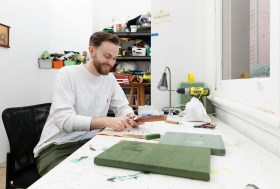


Daniel Nixon is a composer, sound designer and multi-instrumentalist. He has performed with the MSO, Orchestra Victoria, John Farnham, Yothu Yindi, Sebine Meyer, Mikko Frank and many others. He has written and recorded multiple albums and worked extensively as a session player, programmer and producer.
He has also scored and designed numerous films, games, ads, plays and dance works including work with Flashgun Films, Cascade Films, Little Ones Theatre, Red Stitch Actors Theatre, American Girl, Universal Television, Disney Pictures, Melbourne Theatre Company, Queensland Theatre, Dirty Pretty Theatre, Griffin Theatre Company, Ensemble Theatre, Madman Entertainment, NBCU, ABC, Netflix, Arts House, HBO, Farmhand films, and many others.
His most recent work can be heard in Malthouse Theatre’s audio adaptation of Loaded by Dan Giovannoni and Christos Tsiolkas, based on Tsiolkas’ novel.
How would you describe what you do?
I support the telling of stories. I create sonic content designed to enhance the experience of seeing a story unfold.
What skills do you need to be a sound designer?
Musical knowledge is a massive advantage. Good rhythm especially. An ear for detail, and an understanding of the appropriate equipment. The most important thing is an active imagination, coupled with the technical knowledge to realise your ideas.
How did you get started in this career and what was your first job?
I originally trained as an orchestral bassoonist. I was lucky enough to get some fantastic opportunities early on, so I quickly realised that wasn’t the life for me. I switched over to live electronic music and had a fantastic time running around playing parties and festivals and so forth. Recording with various producers during that time led me into writing backing tracks for pop songs, which in turn landed me my first feature film score. A couple of friends were working on a show at Red Stitch around that time, and knew the director was looking for a cinematic composer to design the sound. So I met with him and I’ve been designing shows ever since.
What’s an average week like in your job?
The best thing about my job is the fact that there is no such thing as an average week. I could be writing music, sitting quietly somewhere recording location sounds, off sourcing scrap metal to scrape or smash, strapping a swimmer to a diving board with giant rubber bands to capture the sounds of splashing, recording dialogue, mimicking someone’s footsteps, working with singers and instrumentalists, or just pacing around the house swearing to myself until I’ve found an answer to whatever problem it is I need to solve.
I’m looking forward to theatres opening up again so I can get back into setting up spaces for live performance, going on tour, or sitting in on rehearsals testing content. The variety in my work is a big attraction for me.
What’s the biggest misconception about sound design?
A lot of people assume I’m an audio technician. While that is a part of what I do at times, my real passion lies in content creation. The tech side of things is just a means to an end.
If you were interviewing someone for your job, what would you be looking for?
Dedication, passion, attention to detail, imagination, openness to working collaboratively and the ability to stay calm under pressure, particularly when very short of sleep. There’s some technical stuff you need to know, but most importantly a good attitude and a solid commitment to the ridiculous is all you really need.
What’s new and exciting in sound design today?
The advancements in digital sound recently have opened up a whole new world for sound designers. The ease of access to incredibly powerful software these days has really expanded the possibilities. When I was starting out, I was always very focused on analogue sound, because the digital usually sounded terrible. But things have changed.
I will always love the warmth and unpredictable nature of analogue, but nowadays digital is not necessarily better or worse, it’s just different. And the fact that you no longer need to spend a small fortune just to get started means that anyone with a laptop and the inclination can give it a go.
More in this series:
So you want my arts job: Artistic Director
So you want my arts job: Projection Artist
So you want my arts job: Picture Book Illustrator
So you want my arts job: Audio Describer
So you want my arts jobs: General Manager
So you want my arts job: Google Arts and Culture lead
So you want my arts job: Madman Marketing Manager
So You Want My arts job: Mona Curator
So you want my arts job: Fight Director
So you want my arts job: Circus Rigger
So you want my arts job: Circus Trainer