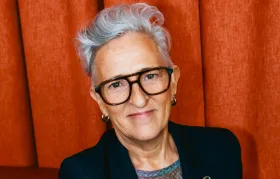
Zooming with Jo Dyer in the week before her final Adelaide Writers’ Week (AWW) was a masterclass in multitasking. In the time we talked there were emails from cancelling authors, phone calls she acknowledged but didn’t answer and, that staple of working from home, a knock at the door from an unexpected road worker. Throughout all this, Dyer remained calm, yet excited about the festival she launched on Saturday.
With 2022 as her fourth and final festival, Dyer has come to be pragmatic about the changing nature of events and those last-minute changes. ‘We call it when you’re “in the river”, because you’re just having to go with that flow,’ Dyer explained.
‘Things which may have felt like a big crisis previously are just part of the moving currents that you’re trying to desperately stay afloat on and not be swept away by. But actually going down the river can also be kind of fun if you get caught in it at the right time and the right moment.’
That ability to lean into change is a hallmark of Dyer’s career with a CV that includes a period as General Manager of Bangarra and as Artistic Director of Sydney Theatre Company under Robyn Nevin then Cate Blanchett and Andrew Upton. Not to mention her stint as CEO of Sydney Writers Festival, and somewhere in the mix she has also been a producer on two films (Lucky Miles and Girl Asleep). But she became best known for her role in the rape allegations against Christian Porter, where she took a principled stand to legally challenge the Liberal’s former attorney general and was awarded damages. And this all played out as she was running 2020’s AWW.
How does she keep going when the river seems like a deluge? ‘I think there is a kind of a buoyancy born of hope that you have to keep with,’ Dyer said. ‘The rhythm of a festival is so different from the rhythm of a production company and having worked in both, the differences are really stark. With a production company, you’ve got things happening every year, every minute. You’ve got to have one opening night and then you’re looking to the next one almost immediately.’
Like many events though the pandemic, AWW had to adapt with changing conditions, though perhaps not as dramatically. Unlike most other pandemic events it managed to avoid closing down or going exclusively online. In retrospect it seems to have been a good decision but with borders closing in 2020 it made for a logistical nightmare.
But Dyer kept positive. ‘In the early days of COVID, doing something just felt better than doing nothing,’ she said. Set in the Pioneer Women’s Memorial Gardens, so much of AWW is about the physical place. Dyer didn’t want to lose that in the pandemic. ‘We are an outdoor event, it’s a free event. It is more like a music festival vibe in some ways that you have and being able to wander between the stages and sit around and have a glass of wine in the sun.’
So the show went on and this year (while it meant adding new health precautions like masks and fenced in areas to control crowds) the event is proving as successful as ever. Dyer reflected that audiences remained strong and that they were ‘very lucky to have a really dedicated and really committed audience. And a lot of the audience they look forward to Writers Week, every year and they take leave, and they come to the whole thing.’
COVID-19 did (and continues) to make programming difficult. ‘One thing that we did notice in terms of absent friends was, particularly when Melbourne went through its outbreak [in 2021], is that a lot of our older authors withdrew. And by the time we got to Writers’ Week, I don’t think we had a single author left, who was over the age of 65.’
This year Dyer has a program that looks to the big issues facing the nation from sexual harassment to climate crisis to identity politics. ‘Some of them are thrown up by the books that you see published. Some of them you seek out perspectives on discussions that have been playing out in the kind of national discourse,’ Dyer offered.
The result is a program that shows Dyer’s keen political interests (with a session involving Kevin Rudd and Malcolm Turnbull) but holds space for communities to represent themselves. ‘We’ve got a whole series on memoir this year, Tell Me Your Story, with really different and diverse perspectives and stories being told whether it’s Veronica Gorrie or Brandon Jack. We want to have lots of different stories coming from very different perspectives and giving us different insight into our country and our fellow citizens.’
What I’m also mindful of is that a festival director comes and curates for a time and part of their job is to bring their taste to what they do. So they are using their own taste and preoccupations and areas of interest as part of the program though always being mindful of the audience as well.
Dyer does feel like her term has seen a growth in ideas and non-fiction as many festivals have to wrestle with the times we live in. She’s conscious her approach might not be for everyone. ‘You can’t outstay your welcome either in my position,’ Dyer laughed. ‘This has been my fourth Writers’ Week and I’m aware that my priorities and preoccupations may not be shared by all of my audience.’ She noted that her festivals have always been successful ‘and we’ve seen that in the attendances and the book sales. But it feels appropriate now to pass the baton on to someone else.’
Dyer’s recent announcement that she will run at the Federal Election for the seat of Boothby points her career in yet another direction. She’s one of many women – including columnist Jane Caro and journalist Zoe Daniel – who are running as independents as they no longer see mainstream politics representing them.
‘A lot of women who are saying, “We’re not going to stick to our lane because we don’t like what you’re doing in yours and what you do in yours impacts on all of us. And it’s no longer good enough. So let’s try something very different.” It’s often the case that you have to imagine something first before you can get out and change it,’ Dyer told ArtsHub.
That need for change is also at the heart of Burning Down the House, the essay she wrote last year while putting the finishing touches on this year’s program. The book opens by labelling Australia as a kakistocracy (a state led by its least suitable citizens) and reads like an alarm bell for our democracy as it bounces between Robodebt, the 2019 bushfire response and sexual abuse in Parliament. It wraps up with a provocation to embrace independent candidates and the possibility of a hung parliament as a way to hold our politicians to accountability. ‘Its starting position is that we are experiencing poor leadership, in some cases, amoral leadership, and, and how have we got here.’
While some may question if Dyer’s diverse experience as an author, festival director and more will prepare her for politics, Dyer sees it as an advantage.
I think having an arts background and an artistic sensibility as a politician will be liberating, important and revelatory for others around me. It would be a wonderful thing, if we had more artists involved directly in the political process.
While she’s realistic about taking on a campaign so soon after the festival, Dyer sees the attributes of artists as having a lot to offer politics. ‘The thing about the arts sector is that it takes you back to the fundamentals really – very often and very regularly. The artist embraces the ideas of courage and imagination and sacrifice. They are unafraid to think deeply and meaningfully about core issues to humanity.’
But after juggling so many roles, how does she relax? Dyer laughed, ‘If things don’t end up with me having to quickly pack my bags for Canberra, the great thing that I will be able to do is start reading the big pile of books that have been gradually growing by the side of my bed…’
Adelaide Writers’ Week 2022 runs from 5 March to 10 March.
Burning Down the House: Reconstructing Modern Politics by Jo Dyer is published by Monash University Press as part of their In the National Interest series.
The writer attended Adelaide Writers’ Week as a guest of Adelaide Festival.